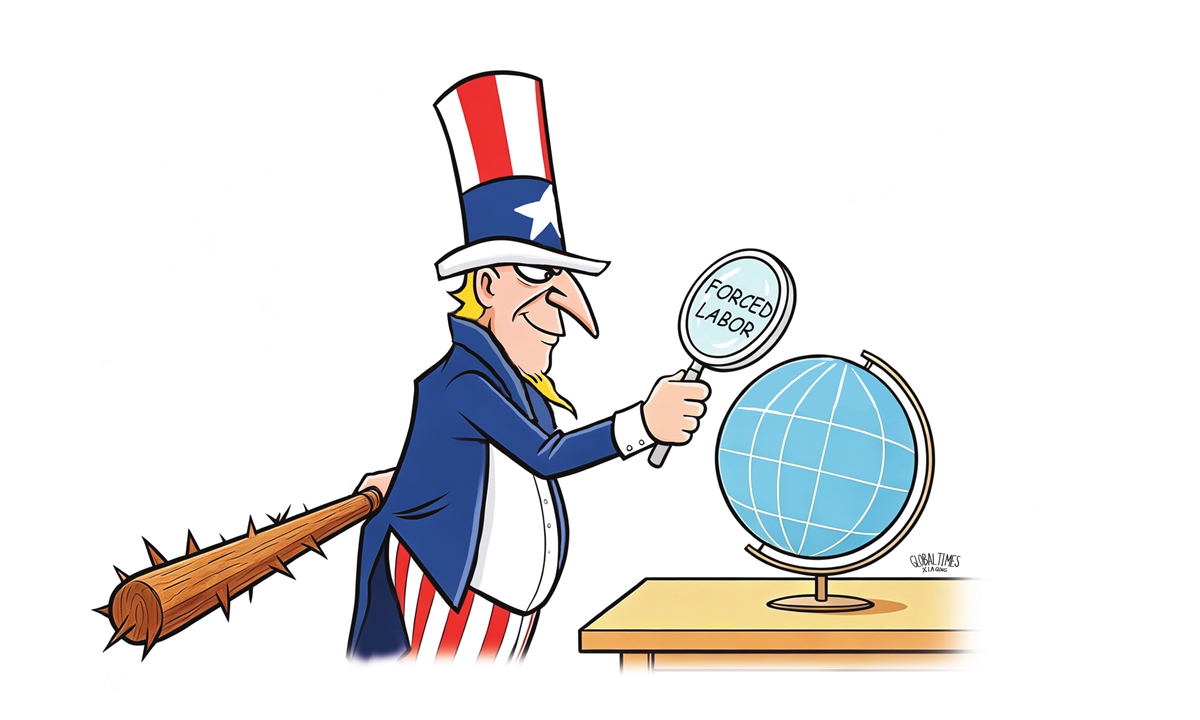
opinionThe US recently imposed new tariffs on 60 economies, including China, on the grounds of “forced labor,” and then added more than 40 Chinese companies to its Uyghur Forced Labor Prevention Act Entity List. These moves are entirely without factual basis. In reality, they represent economic coercion carried out under the guise of “human rights” and “forced labor,” driven by geopolitical calculations and coming at the expense of the interests of other countries, particularly those in the Global South.The “forced labor” narrative promoted by the US is marked by blatant double standards. The US is among the few countries that have yet to ratify the International Labor Organization (ILO)’s Forced Labor Convention, 1930, which recognizes forced labor as a crime. Historically, one reason the US has not ratified the convention is that its prison labor system allows private companies to profit from incarcerated workers, a practice inconsistent with the convention’s principles.Regarding the latest tariffs imposed under the pretext of “forced labor,” the US has even claimed that whether a country has ratified relevant ILO conventions or taken domestic measures to combat forced labor is not part of its standards. This means that whether a country is committed to protecting labor rights is no longer judged by if it improves working conditions, safeguards workers’ interests or punishes companies that break the law. If a country meets standards and requirements unilaterally defined by the US, it is therefore deemed to be protecting labor rights.By invoking “forced labor” as a pretext, the US is engaging in economic coercion and bullying, dealing a severe blow to actors at the lower end of global value chains and potentially undermining the industrialization efforts of some Global South countries. First, it creates significant third-country spillover effects. The US does not only examine the country of origin of finished products; instead, it emphasizes whether relevant inputs are used “wholly or in part,” leaving companies in countries such as Vietnam and Malaysia facing US scrutiny over the origins of upstream inputs and so-called supply chain regulatory compliance risks.Second, it significantly raises the barriers for small and medium-sized enterprises from Global South countries to participate in global value chains. The supply chain traceability requirements demanded by the US go far beyond simply providing a certificate of origin; companies may be required to prove the source, ownership and transaction relationships across the entire chain. Enterprises with smaller scale, lower levels of digitalization and weaker verification capacity face especially severe challenges.Third, it undermines Global South countries’ participation in regional economic integration. For example, the African Continental Free Trade Area (AfCFTA) aims to expand regional trade and promote regional industrial chains. However, under the US logic of scrutinizing products that are produc