







 Ροή Ειδήσεων
The (lost for the USA) war in Iran strains American weapons stockpiles and raises doubts about the ability of Washington to protect the Persian Gulf.
If this development weakens the petrodollar and prompts oil-producing nations to move away from the American financial system, two assets will confront clear headwinds: the US dollar and American government bonds, US Treasuries.
This constitutes the greatest transformation of the economic, monetary, and financial system since 1971, when President Nixon severed the dollar from gold, rendering the Bretton Woods agreements of 1944 a thing of the past.
The petrodollar system helped generate structural demand for both.
If oil exporters sell greater quantities of energy outside the dollar system, fewer petrodollars will need to return through Wall Street and be channeled into American sovereign securities.
The demand for debt
At the same time, the American government needs to borrow astronomical sums to finance its fiscal deficits, military commitments, entitlement programs, and interest expenditures.
This means that the growing supply of American government bonds may clash with weakening structural demand for them.
Watch the yield on the 10-year American government bond.
The yield on the 10-year American government bond represents perhaps the most important financial benchmark in the global fiat currency system, as it influences valuations and market trends throughout the world.
It is widely, and mistakenly, regarded as the rate of return on a risk-free investment.
The yield on the 10-year American government bond can be considered a key indicator of the health of the dollar-based monetary system, a vital metric analogous to its heartbeat.
Bond yields move inversely to their prices.
When bond prices fall, their yields rise.
A rise in the yield of the 10-year American government bond is a warning sign for the dollar, as it signifies that investors are selling American sovereign paper, a fact that drives up borrowing costs for the American government.
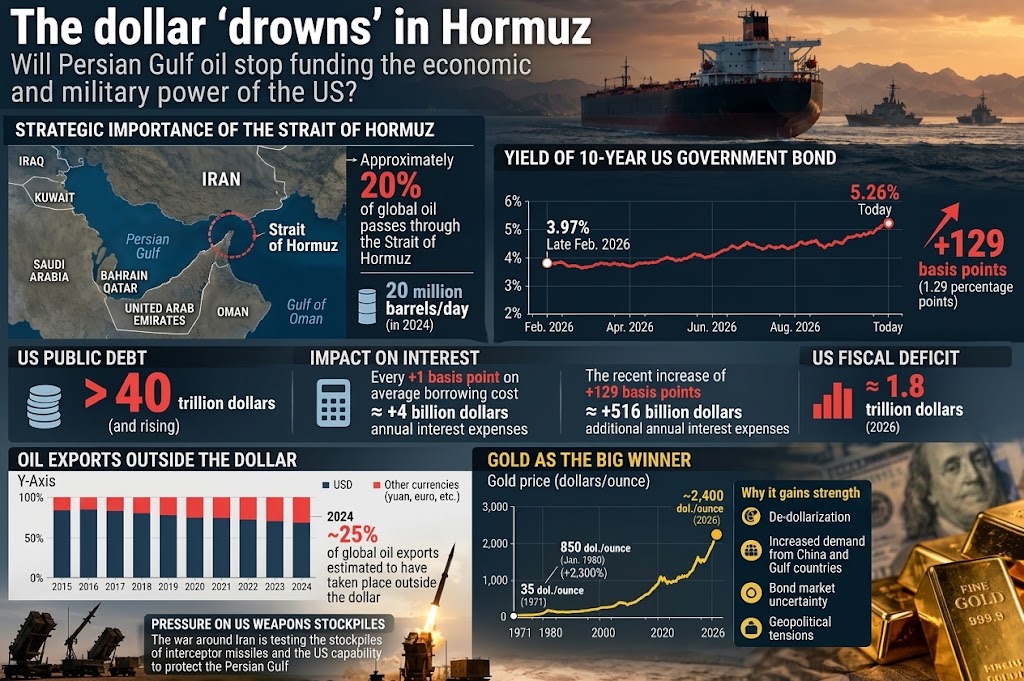
Data processing: BN
That is why the yield on the 10-year bond constitutes one of the most significant pressure points for the US government.
In late February 2026, the yield on the 10-year American government bond stood at 3.97%.
Today it stands at approximately 5.26%, recording an increase of about 129 basis points.
129 basis points may not seem like much, but with national debt exceeding 40 trillion dollars and constantly expanding, every basis point matters.
At current debt levels, every one-basis-point increase in the government’s average borrowing cost adds approximately 4 billion dollars to annual interest expenditures.
Consequently, an increase of 129 basis points is by no means negligible: it translates into nearly 516 billion dollars in additional annual interest expenses, significantly widening a fiscal deficit that already stood at roughly 1.8 trillion dollars.
It is estimated that the yield on the 10-year American government bond will continue to climb in the coming weeks and months, until it forces the Federal Reserve (Fed) to intervene.
At that juncture, intervention will be presented as a measure for «stability», but the mechanism will be familiar: capping yields through the debasement of the currency’s purchasing power.
This vicious feedback loop could constitute one of the defining investment stories of the coming years.
The big winner
The biggest winner should come as no surprise: Gold.
China and major oil-producing nations of the Middle East have been accumulating gold for years. I do not believe this is a coincidence.
They sit near the epicenter of the shifts taking place across the international monetary system.
China produces more gold than any other country and ranks among its largest consumers.
No one outside Beijing knows how much gold the Chinese state truly controls, but its official reserves disclose only a fraction of the total picture.
China has also spent years constructing the necessary infrastructure to connect trade conducted in yuan with physical gold markets.
This groundwork makes far more sense when we view gold not as a commodity, but as a neutral settlement asset for transactions.
Monetary transformation
The last monetary transformation of comparable magnitude began in 1971, when Richard Nixon severed the link between the dollar and gold.
Under the former system, gold traded at 35 dollars per ounce.
By January 1980, its price had reached 850 dollars, marking an advance of over 2,300%.
I believe the monetary shift unfolding today could prove just as momentous.
For over half a century, the petrodollar system helped generate structural demand for dollars and American sovereign debt.
It empowered Washington to run persistent fiscal deficits and export dollars abroad at a scale no ordinary country could sustain.
Americans have grown accustomed to viewing this privilege as a permanent feature of the financial landscape.
It is not.
At first glance, the depletion of American interceptor missile stockpiles might appear unrelated to the future of the dollar.
It is not. Both depend on the same underlying reality: the ability of the USA to project its massive financial clout into real economic and military strength.
Washington can create dollars without limit.
It cannot, however, conjure missile factories, rare earth supply chains, control of the Strait of Hormuz, or trust in American security guarantees at the push of a button.
If the war in Iran exposes the limits of American military power, drives the Persian Gulf states toward an understanding with Iran and China, weakens the role of the dollar in oil trade, and accelerates the reorientation of global foreign exchange reserves toward gold, we may look back upon this period as the moment the post-1971 monetary order entered its terminal phase.
What began with an interceptor missile shortage leads to a far broader conclusion: the war in Iran reveals the limits of both American military power and the monetary system that this power has underpinned for over half a century.
The signs to watch are clear.
Watch the oil-producing nations.
Watch the dollar.
And above all, watch gold.
The retreat of the petrodollar could force Washington into even greater monetary issuance, endangering the purchasing power of American citizens and the potential for economic recovery.
The adaptation of the global economy to a post-dollar monetary system will give birth to a new world.
www.bankingnews.gr