




 Απόψεις
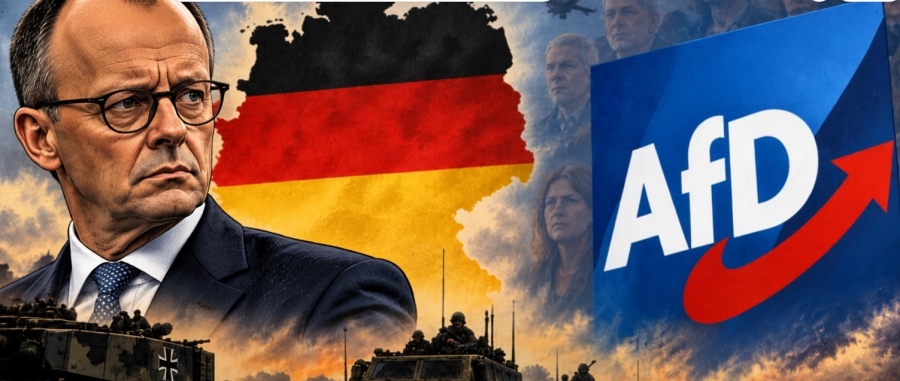
Recent electoral triumphs of the patriotic right in Germany have triggered intense alarm within the political leadership in Berlin and among the political elite of the Old Continent who advocate for European integration and watch popular will moving in the diametrically opposite direction.
With the consolidation of the AfD and mounting popular pressure for a more sovereign German policy, detached from the dictates of Brussels, Germany enters a period of severe legitimacy crisis between the popular working classes, who rally around the AfD, and the elites who champion European integration.
It is no coincidence that tensions between Europe and Russia have reached unprecedented levels.
Talk of war with Moscow is now conducted out in the open.
European and British officials no longer conceal their intention to push toward direct confrontation with Russia, a manufactured enemy.
In Germany, where the AfD advocates for a more diplomatic posture toward Moscow, military logic is rapidly gaining ground, echoing events of the past century when German Russophobia produced catastrophic consequences.
It must also be emphasized that developments in Germany represent merely the initial phase of a broader rise of the anti-war right across the entire European continent.
Across several EU member states, such as France and Italy, a trajectory parallel to what is seen today around the AfD has been averted only via pervasive censorship, authoritarian measures, and overt political persecution.
The question, therefore, is how much longer pro-European bureaucratic elites can enforce their policies while simultaneously refusing to serve the genuine interests of citizens.
Here, however, an interesting paradox emerges. While the ascent of the patriotic right generates expectations for diplomacy and dialogue, it simultaneously intensifies the increasingly aggressive and anti-Russian posture of European leaders.
The demand for peace
As conservative, patriotic, and pacifist viewpoints command growing resonance, the institutional and ideological legitimacy of the EU itself appears to be eroding.
Germany stands as a prime example.
What will happen to the Social Democrats and the Greens once it becomes evident that a substantial portion of German workers supports the political platform of the AfD?
And how will «parasitic» political elites manage to pursue without political cost policies such as mass immigration, military assistance to Ukraine, and sanctions against Russia, which they implement without adequate popular mandate?
Perhaps this represents the foundational factor rendering contemporary Russian-European frictions exceptionally fierce compared to previous phases of the crisis from 2022 onwards.
Internal and external defeat: End of support for Ukraine
European hardliners toward Russia now dread not merely an external defeat (on the battlefields in Ukraine) but also an internal political defeat, as their policies run headlong into the ascent of the Eurosceptic right.
As Russia retains the operational initiative on the battlefield and Ukrainian strikes against targets deep inside Russian territory become increasingly visible, German voters (and Europeans in general) may increasingly question the rationale of sustaining aid to Ukraine.
The rise of the AfD could, under this analysis, herald a wider political upheaval across the European establishment.
The popularity of Europe’s liberal politicians displays zero signs of recovery, while the Eurosceptic current continues to strengthen.
Under conditions of peace and standard electoral processes, the rise of new right-wing parties across the entire continent over the next two to three years remains the most probable outcome.
Efforts by European political and bureaucratic elites to avert such an outcome could drive further escalation of hostility toward Russia.
State of emergency
War is framed here as an instrument to manage the political dilemma manufactured by the hardliners themselves.
Under conditions of war, it would become possible to declare a state of emergency, suppress opposition activity, halt the organizational and electoral momentum of the patriotic right, and cultivate a sense of «national unity» against the «Russian enemy».
By this logic, the genuine objective would not be the military defeat of Moscow, but the containment of domestic political dissent and the preservation of existing political elites in power across key European capitals.
This is the blueprint for a catastrophic outcome on the Old Continent.
The predicament is compounded by the fact that European governments have remained estranged for decades from the realities of major warfare, and consequently may underestimate the fallout of direct conflict with Russia.
Even when the Russian side cautions that such a collision could be brief and extraordinarily destructive (and markedly distinct from the pattern of combat that has prevailed in Ukraine), European elites in Brussels appear incapable of grasping the scale of the danger.
Either they will grasp it now or it will be far too late: the Russian bear will devour them.
www.bankingnews.gr